When a sandstorm in Dubai blows itself out, the wind drops overnight and the sky clears to a flat pale blue. A balcony in Dubai Marina or Emirates Hills can be left with outdoor furniture gone the colour of the desert and glass streaked into something worse than dirty. The first instinct is to reach for a hose. That instinct is usually wrong, and the order of the next few hours decides whether the flat is clean by lunchtime or grey again by Thursday.
The glass is the part everyone notices, and its outside face is the hardest part to reach, which is where glass and window cleaning comes in. But the glass comes late in the sequence, not first. A dust event feels like bad luck. It is closer to a season with a rhythm, and that rhythm is described in the meteorological literature.
The winter shamal has a rhythm
The shamal wind in the UAE is the northwesterly that strengthens as winter weather systems and their cold fronts cross the Gulf. A 2022 study by Nelli and colleagues in Frontiers in Environmental Science, Characterization of the atmospheric circulation near the Empty Quarter Desert during major weather events, drawing on earlier research, describes these winter shamal events. They "occur on average twice to three times a month from December to early March." Each one runs on a time-scale of either 24 to 36 hours or 3 to 5 days, depending on whether an upper-level trough stalls near the Strait of Hormuz or moves quickly east.
Two things in that description change how the work should be planned.
The first is frequency. On that average, two or three events a month from December into early March means the same surfaces take the same load again and again. A clean in the middle of January can be followed by another event within weeks.
The second is duration, and it catches people out. The same kind of event can last a day and a half or several days, and from a balcony there is no telling which on day one. Booking a clean for the second morning of a five-day event means paying for a visit the wind undoes by the afternoon. The National Center of Meteorology publishes forecasts, a warnings map and sandstorm awareness guidance, and the useful question to ask of them is when the wind is expected to drop. The clean belongs on the morning after that, not the morning after the event started.
Why the weaker summer shamal moves more dust than the stronger winter one
It is natural to assume the hardest wind of the year leaves the most dust behind. The same paper says otherwise: "While the winter Shamal events are generally stronger than their summer counterparts, the latter play a larger role in the dust activities in the Arabian Peninsula." It also notes that dust events in the UAE peak in summer, with a secondary maximum in late winter associated with the cold fronts.
So there are two different problems wearing the same name.
The summer problem is volume. The research links summer shamal events to more of the region's dust activity, so dust is not only a winter job, and glass and balconies carry a load through the hot months as well.
The winter problem is force and repetition. Winter events are generally stronger, and they arrive in a run from December into early March. Where the material ends up, and how to get it out, is covered in the sections on tracks, seals and drains below.
Northwest: the prevailing wind, and which face to check first
For anyone in a tower, the most useful line in the paper is this one: "The large-scale winds in the UAE blow predominantly from the northwest."
That is a statement about the prevailing wind, not about any single building. A phone compass shows which elevation faces into that wind, so check those panes and that end of the balcony first.
Where the dust settles indoors and on the balcony
Dust does not spread evenly. It collects where air slows down and where a surface can hold it. After an event, a short list of places holds the material, and most of them are not the first places anyone looks.
Window tracks and seals hold the most
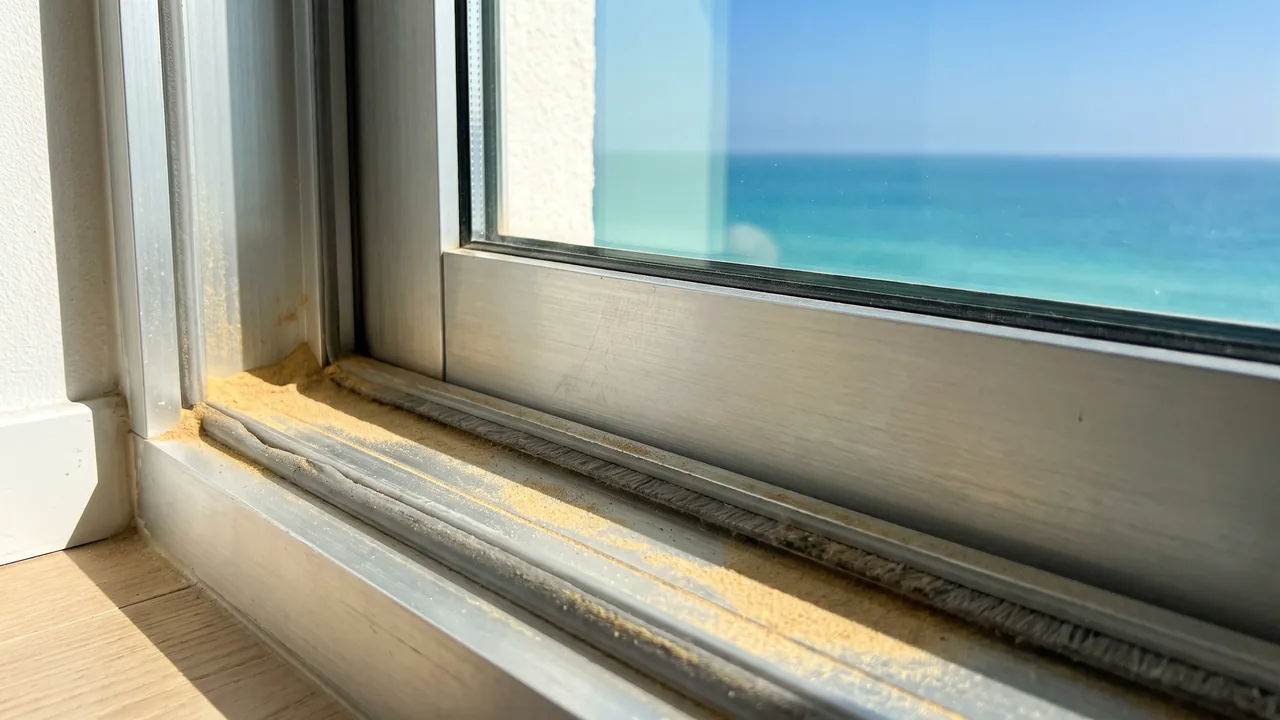
The bottom track of a sliding door is a trap: a channel, a drainage slot and a brush seal, all at floor level, all facing the weather. Fine material can pack into the corners and into the gap behind the rubber, then grind against the roller every time the door moves. A door that feels heavy or judders after a windy spell is worth checking for packed dust before anything else.
The mistake is to spray the track and wipe. Water turns packed dust into a paste that sets in the corners and clogs the drainage slots. The track comes out dry first, with a brush and a narrow vacuum nozzle, and only then gets wiped.
Balcony drains block from above, and curtain hems catch the rest
Balcony drains fill quietly. A drain blocked by dust may not show itself until the first proper rain of the winter, when water can spread across the balcony floor and under the door. Clearing loose dust from the grate, dry, before the rain, is a small job. Clearing it afterwards is a larger one: a drain that is properly blocked is plumbing work, a separate job from the clean.
Curtain hems are the indoor equivalent. Fabric that touches or nearly touches the floor near a balcony door catches whatever gets past the seal. Shaking a curtain in a closed room moves the problem onto surfaces that were just cleaned, which is why curtains are dealt with before the floors.
Pools, car ports and return grilles need the same dry-first logic
An open pool after a sandstorm has two problems: debris and chemistry. Fine dust drops through the water and settles on the floor, the surface goes dull, and the skimmer baskets and filter fill faster than usual. The baskets are emptied first. The walls are brushed before the floor is vacuumed, because material left on the waterline gets pushed around rather than lifted. The filter is cleaned so it is not working against the rest. A load of debris can shift the chemical balance, so the water is rebalanced as part of the pool service, not just skimmed.
Car ports and covered parking behave like wind tunnels. The dust arrives, slows down, drops and stays. It gets swept out dry before any hose goes near it, for the same paste reason as the tracks.
AC filters and return grilles load up during an event, and a loaded filter recirculates what it fails to catch. Filter cleaning and replacement are AC maintenance, booked alongside the clean rather than as part of it. If the filters are left until last, the rooms get dusted twice.
Leave the glass until the wind drops
Cleaning exterior glass while the wind is still carrying dust does not last. Airborne dust lands on the wet glass and dries into streaks, and the pane can end up looking worse than before the visit. The same goes for hosing a balcony while the air is still full of dust.
The right move during an event is defensive and quick: close doors and windows, roll up or cover outdoor cushions and soft furniture, lift what can be lifted off the balcony floor, and leave the glass alone. The cleaning is booked for after the wind drops, which is why the duration question matters. A 24 to 36 hour event is over within a day or two. A three to five day event is not, so check the forecast before booking.
The order of work after a sandstorm: dry before wet, high before low
The sequence exists because each step would otherwise be undone by the one after it.
| Stage | What it covers | Why it comes here |
|---|---|---|
| 1. Dry removal | Brushing and vacuuming window tracks, sills, door seals, balcony drain grates, outdoor cushions | Water on loose dust makes paste. Anything wet applied first has to be scraped out later |
| 2. Filters | AC filters and return grilles, an AC maintenance job booked alongside the clean | A loaded system spreads dust over everything cleaned after it |
| 3. High surfaces | Curtain rails, curtains, upper window frames | Whatever is disturbed up here falls, so it has to fall before the floor is done |
| 4. Glass and frames | Interior glass and frames, then exterior once the wind has dropped | Needs clean tracks and clean surrounds, or the frame dirties the pane on the first wipe |
| 5. Low and wet | Floors, balcony wash-down, final wipe of horizontal surfaces | Catches everything the four stages above brought down |
Reverse any two of those and the work is done twice.
Towers and desert-edge communities load differently
The same wind produces two different jobs depending on where a property sits.
In villa communities that back onto open sand, the work is mostly outdoors and at ground level: driveways, car ports, sand banked against garden walls, gate tracks, gravel and planting beds. Gate tracks and outdoor drains are the pinch points, and they take the same dry-first treatment as a sliding door.
In Marina, JBR, Downtown and Business Bay towers the problem is height. The dust that matters sits on glass and balconies that are hard to reach: the outside face of a pane forty floors up, a balcony exposed on more than one side, and the sliding door seal that stands between the flat and the weather.
The practical difference is who can reach it. A villa's clean-up is mostly reachable work: tools, time and the right order. A tower's is split. The inside is reachable work, and the outside face of the glass is not.
The outside of the glass: poles, drones and no scaffolding
Interior glass is the easy half. The outside face is where the dust arrives and where it stays, and in most residential towers it cannot be reached from the flat.
OUSIS glass and window cleaning covers both faces. For high-rise buildings, exterior glass is cleaned with water-fed pole systems, and facades with drone-assisted cleaning by certified operators. No scaffolding goes up.
That matters more in sandstorm season than at any other time of year, because the whole point is timing. The aim is to clean in the gap between events, and with no scaffolding to arrange, that gap is far easier to use.
Solar panels collect the same load on an open, tilted face. OUSIS cleans them with pure water and no chemicals.
A season, not an event
Treated as an emergency, a sandstorm means waiting until the balcony is unusable, then looking for a free slot on the first clear morning after the wind drops.
A scheduled visit holds a property at a steady state instead of a sawtooth. OUSIS runs weekly, fortnightly and monthly contracts, and for most properties that means scheduled villa and building cleaning set up before December, exterior glass timed to the clear days between events, and one decision made in advance about who checks the balcony drains before the first rain. For short-let units, December to March is also the busiest turnover season.
For a one-off after a bad event, a photo of the balcony and the glass sent on WhatsApp (+971 58 513 1338) gets a clear quote, usually within the hour. Bookings are normally made a day or two ahead, with same-day or next-day visits via WhatsApp subject to availability. The season has a known rhythm. The response can have one too.
Questions people ask
What should I clean first after a sandstorm in Dubai?
Start dry. Brush and vacuum the loose dust out of window tracks, door seals, sills, balcony drain grates and outdoor cushions before any water goes near them, then deal with AC filters, then high surfaces such as curtains and rails, then glass and frames, and finish with floors and the balcony wash-down. Water on loose dust makes a paste that has to be scraped out later.
Should I clean windows during a sandstorm in Dubai?
No. Wet glass cleaned while dust is still in the air picks up fresh material and dries streaked, often looking worse than before. During the event, close doors and windows, cover or bring in soft outdoor furniture and leave the glass alone. Book the exterior clean for the first clear morning after the National Center of Meteorology expects the wind to drop.
How do I get sand out of sliding door tracks?
Work dry first. Brush the track and use a narrow vacuum nozzle to lift packed dust from the corners, the drainage slots and the gap behind the rubber seal. Only wipe once the loose material is gone. Spraying water first turns fine dust into a paste that sets in the corners and blocks the drainage slots.
Should I hose down my balcony after a sandstorm?
Not first, and not while the wind is still carrying dust. Sweep and vacuum the loose material off the floor, the drain grate and the door track while everything is dry, then wash the balcony down as the last step. Hosing first washes paste into the track and the drain, and a drain that blocks is a plumbing job rather than a cleaning one.
When is sandstorm season in the UAE?
There are two shamal periods. Winter shamal events, linked to cold fronts crossing the Gulf, occur on average two or three times a month from December to early March, according to a 2022 study in Frontiers in Environmental Science. Summer shamal events are weaker but play a larger role in the region's dust activity, and dust events in the UAE peak in summer.
How soon after a sandstorm should the windows be cleaned?
Once the wind has dropped, not while the event is still running. Published research puts winter shamal events at either 24 to 36 hours or 3 to 5 days, and the two look the same on the first day, so check the National Center of Meteorology forecast for when the wind is expected to ease and book the exterior glass for the morning after.
Sources
- Nelli et al., Characterization of the atmospheric circulation near the Empty Quarter Desert during major weather events, Frontiers in Environmental Science, 29 August 2022
- National Center of Meteorology (UAE), Warnings Map, accessed 19 September 2026
- National Center of Meteorology (UAE), Sand Storms awareness page, accessed 19 September 2026
- National Center of Meteorology (UAE), Weather Forecast, accessed 19 September 2026