Black spots on bathroom grout, along the silicone at the shower tray or on the wall behind a wardrobe raise one question first: is this a cloth or a contractor? Before deciding, measure it. Dubai Municipality draws the line at ten square feet, just under one square metre. Under that, its guideline says the work can "typically" be "handled by building maintenance staff with necessary precautions". Between ten and one hundred square feet, "professional remediation may be required depending on the building type and occupancy". Above one hundred square feet, it is necessary.
Area is the first test. It is not the last one. For a small patch, the surface is what a deep clean deals with; the water feeding it is a separate job, and it has to be found first.
Ten square feet: the Municipality's own test
The document is the Technical Guideline for Mold Remediation and Control (DM-HSD-GU142-MRC2), from the Municipality's Health and Safety Department. The PDF cover reads Version 1, issue date 12 May 2025; the Municipality's document portal lists the same file as V_1-002, dated 16 October 2025. The guideline is written in American English, so every direct quotation below reads "mold", while the rest of this article uses the British spelling.
It asks an assessor to classify "the size of the affected area" as small, medium or large, and says this "helps determine the level of response required".
| Level | Affected area | What the guideline says |
|---|---|---|
| Level 1 (Small) | Less than 10 square feet | "Typically, this can be handled by building maintenance staff with necessary precautions." |
| Level 2 (Medium) | Between 10 and 100 square feet | "Professional remediation may be required depending on the building type and occupancy." |
| Level 3 (Large) | More than 100 square feet, or significant contamination of HVAC systems, or large-scale water damage | "Professional remediation is necessary in these cases." |
Ten square feet is about 0.93 square metres. A large bath towel laid flat against the wall is roughly the line. A stain that runs the width of a bedroom wall behind a wardrobe is usually past it.
Level 1, in practice. The guideline does not write a separate precautions list for small patches, but its own inspection checklist names the protective equipment as "gloves, respirators, and coveralls", and its cleaning method for non-porous and semi-porous surfaces is a damp cloth with "a mild detergent solution", with the warning to "avoid using excessive water to prevent further moisture issues". Dry scrubbing and a flooded bucket are both the wrong tool.
Level 2, in practice. This is the band the guideline deliberately leaves open. The sensible order is: find and stop the water first, tell the building's facilities team (in an apartment, the pipe feeding the patch may be theirs), and treat anything growing on porous board as a removal job rather than a cleaning one. The guideline says to "remove and dispose of materials that cannot be effectively cleaned or have been severely damaged by mold, such as drywall and insulation".
Area is also not the only criterion. The same risk assessment asks about the extent of the water damage behind the growth, the type of mould present, the health of the occupants and the effect on building materials. A small patch fed by an active leak is a bigger problem than a larger one on a wall that has already dried out.
The reason to take any of it seriously is on record. The World Health Organization's 2009 guidelines for indoor air quality on dampness and mould report that "the most important effects are increased prevalences of respiratory symptoms, allergies and asthma", and put the emphasis on "the prevention (or minimization) of persistent dampness and microbial growth on interior surfaces and in building structures".
Why it shows up after the summer
The Municipality puts the background plainly: "Given the hot and humid climate of Dubai, buildings are more susceptible to mold growth." Its prevention advice rests on three things: ventilation, dehumidifiers in moisture-prone rooms such as bathrooms and kitchens, and HVAC systems that are kept working without condensation building up.
When a family travels for part of the summer, a home can lose all three at once. The flat is shut up, the AC is switched off or set high to save electricity, and the internal doors are closed. Nothing moves the air, and nothing dries it.
Humid air gives up its water on anything cooler than itself, which is why the guideline's inspection checklist asks for "signs of high indoor humidity (condensation on windows, walls, or pipes)". In a Dubai home that means the parts the AC makes cold: a chilled water pipe in a service duct, a supply diffuser, the plaster around an AC grille, the casing of a unit that cycles on and off. Where the air never passes through the AC at all, such as a sealed cupboard or the gap behind a wardrobe, it simply stays damp.
The first sign can be a smell rather than a stain, musty and strongest in a room that has been kept shut. The guideline treats that odour as evidence in its own right: persistent odours in areas that have had water damage or high humidity "strongly indicate hidden mold".
Where the water is actually coming from
Mould is a water problem wearing a cleaning disguise. The guideline's inspection checklist treats it that way. Before anything is scrubbed, it asks the inspector to locate sources of moisture ("plumbing leaks or broken pipes", "roof leaks", "flood damage or past water intrusion events"), and it names the places to look, including bathrooms "around tiles, sinks, and tubs", kitchens "under sinks and around appliances", and the inside of "cabinets and closets".
In a Dubai apartment or villa, that gives a short list to work through.
Black mould in the bathroom: the cistern, the silicone line and the extract fan
Black mould on bathroom grout needs a steady supply of water, and three places are worth checking first.
A concealed cistern behind a tiled panel can weep unnoticed, because the water runs down the back of the tile and into the screed. One sign is grout that stays dark at the bottom of one wall while the rest dries. To test it, dry the floor and the panel completely, leave the shower unused for a few hours, and look again. Water that has come back did not come from a shower. It points at the cistern or the pipework behind the panel.
The silicone line where the shower tray or bath meets the wall can fail without looking failed. A fingernail run along it may find a soft section. Water that gets in there goes behind the tile rather than onto the floor, so the bathroom floor can stay dry while the wall in the next room darkens.
The extract fan is the easiest of the three to test. Hold a square of toilet tissue flat against the grille with the fan running. If the fan is pulling air, the tissue stays up on its own. If it drops, the fan is spinning and moving little, for example because the grille is choked or because the duct discharges into a ceiling void instead of out of the building. A bathroom with a dead extract fan puts the steam from every shower into the flat.
Behind the wardrobe and under the sink
A wardrobe standing flush against an external wall creates a pocket of still air that the AC never reaches and never dries. Humid air that finds its way in through the wall, the joinery or the gap at the skirting stays there. The fix is not chemical. It is a gap of a few centimetres and some air moving through it.
Under a kitchen or vanity sink, one thing to check is a fitting that drips slowly onto the chipboard carcass. The board swells before it stains, so a base that has gone spongy at the front edge is a leak report, not a cosmetic issue.
AC belongs on this list for two reasons only. A blocked condensate drain backs water up in the drip tray and into the ceiling void or the wall below it. And a poorly insulated chilled water pipe sweats in its duct, which is why growth can appear in a corridor with no plumbing in it at all. The guideline's checklist asks for ductwork and coils to be inspected "for microbial contamination or water damage".
The number to measure: below 60 per cent, ideally 30 to 50
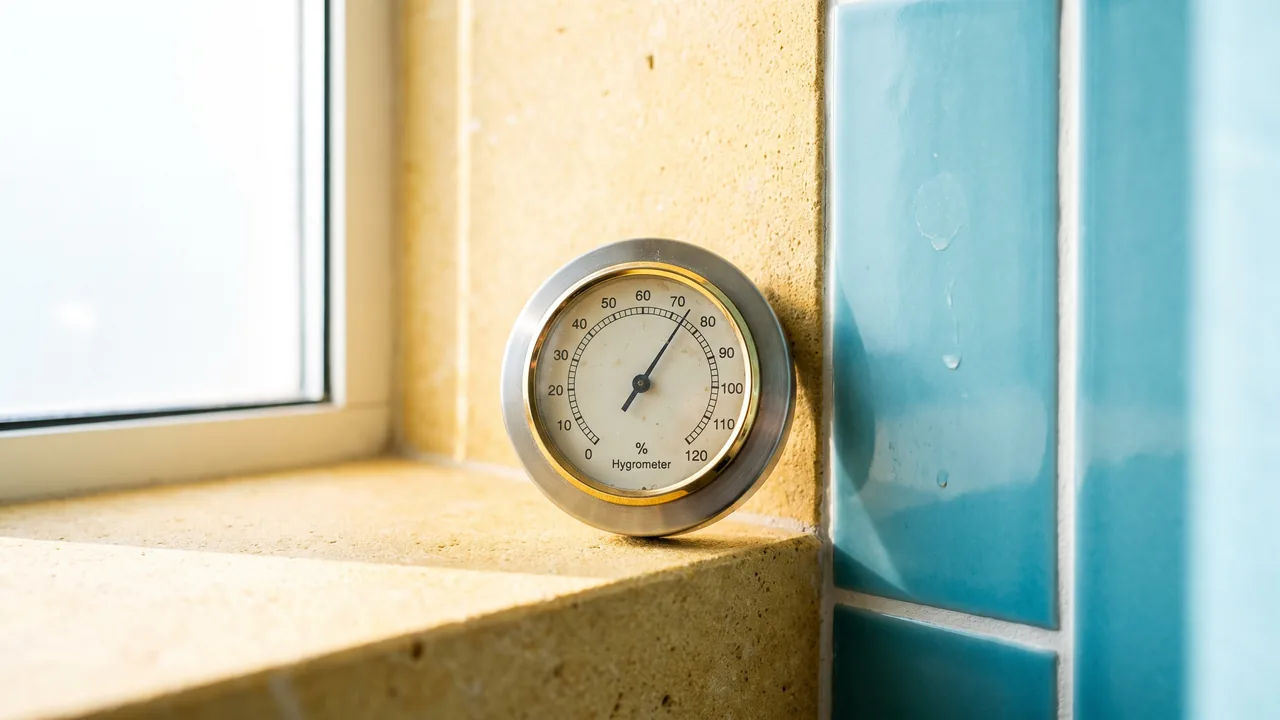
The guideline turns a vague worry into something checkable. Under moisture control it says: "Maintain indoor relative humidity levels below 60%, ideally between 30-50%." Its inspection equipment list includes a "Hygrometer to measure indoor relative humidity (RH)". Its post-remediation checklist sets the clearance figure as "Relative humidity <60% in the affected area", alongside "Moisture content <16% for wood and drywall".
A hygrometer settles the argument. Put one in the affected room, not in the hallway, and read it morning and evening for a week. What matters is the pattern.
- Readings that sit above 60 per cent overnight and fall during the day point at ventilation and how the AC is being run.
- Readings that stay high all day in one room while the rest of the flat is fine point at a source in that room.
- Readings comfortably inside 30 to 50 per cent, with growth still returning on the same patch, point at liquid water behind a surface rather than humidity in the air.
A domestic hygrometer is a decision tool, not a laboratory instrument. The trend and the difference between rooms carry the information.
What a deep clean fixes, and what it does not
Cleaning black mould off a Dubai bathroom is mostly grout work, and the Municipality's own methods are unglamorous: HEPA vacuuming, then damp wiping with "a damp cloth or sponge soaked in a mild detergent solution", and abrasive methods such as wire brushing or sanding for heavily contaminated porous materials like wood and concrete.
On non-porous surfaces (glazed tile, glass, sealed stone), growth can be cleaned off, and it has the best chance of staying off once the water stops. Grout needs working rather than wiping. Silicone that has blackened through is a resealing job, not a cleaning one. Emulsion over gypsum board is porous, and once growth has gone through the paint film into the board, cleaning is cosmetic and the board is a removal job.
Colour is not a diagnosis either. The guideline names Stachybotrys chartarum, "commonly known as black mold", as more hazardous than some other types, but it sends samples to laboratories accredited by the Emirates International Accreditation Centre, not to anyone looking at a stain.
A deep clean covers the part that is genuinely a cleaning job, grout above all, alongside the bathroom sanitising that is part of every villa and apartment clean. Moving furniture out to clean behind it also shows what was hidden, so a damp wall or a swollen cabinet base is seen before it is painted over. When that happens, the next step is a plumbing or AC job, covered below.
Bleaching grout without finding the water only buys time. If the water is still there, the patch can come back on the same line, and the second visit is the same work as the first.
When it stops being a cleaning question
The order of operations is fixed: find the water, stop the water, dry the structure, then clean. The guideline's long-term recommendations put it first, under addressing underlying moisture issues: "Repair leaks, improve drainage, or fix plumbing problems."
In practice that means a dripping tap, a leaking pipe or a blocked drain is a plumbing job, and a blocked condensate drain or a unit that needs servicing is an AC job. A chilled water pipe sweating in a shared service duct may be the building's responsibility, so report it to the facilities team. None of these is a cleaning visit, and none is optional if the growth is to stay gone.
In a rented home, the repair may not be the tenant's to pay for. Dubai's Law No. (26) of 2007, which regulates the relationship between landlords and tenants, says in Article 16 that "unless otherwise agreed by the parties", the landlord is responsible during the lease "for the Real Property maintenance works and for repairing any defect or damage that may affect the Tenant's intended use of the Real Property". Article 19 asks the tenant to maintain the property "in such a manner as an ordinary person would maintain his own property". The tenancy contract can shift that split, so read it, then report a leak behind the wall to the landlord in writing, with photos, before booking any repair.
Above all of this sits Level 3: more than one hundred square feet, significant contamination of HVAC systems, or large-scale water damage. That is where the guideline says professional remediation is necessary, and it belongs to specialist remediation contractors rather than to any cleaning team, OUSIS included. The guideline's remediation checklist describes what that work involves: containment with plastic sheeting and negative air machines where the assessment calls for it, a decontamination chamber for workers and tools, and post-remediation verification that may include air and surface sampling. If a patch is that size, or growth is visible inside ductwork, the right next call is the building's facilities team and a remediation specialist.
Getting the room dry and keeping it that way
Once the source is closed and the surfaces are clean, the work is keeping the number down.
- Leave an air gap behind wardrobes and headboards on external walls, and leave wardrobe doors slightly open during a long absence.
- Run the bathroom extract fan during the shower and for a while afterwards, with the door closed, so the fan pulls the steam out rather than the flat absorbing it.
- For a long absence, plan how the flat will stay below 60 per cent. The guideline's tools are ventilation and dehumidifiers, which it recommends for moisture-prone areas like bathrooms and kitchens.
- Have the AC condensate drain and drip tray checked. The guideline asks for HVAC systems to be cleaned and inspected regularly "to ensure proper functioning and avoid condensation buildup".
- Keep the hygrometer in the room that had the problem.
Clearance is not a feeling that the room smells better. It is the same test the guideline uses: no visible growth, surfaces clean and dry, moisture content below 16 per cent in wood and drywall, and relative humidity back under 60 per cent in the affected area. For day-to-day living, the guideline's ideal range is 30 to 50 per cent. If that reading holds over the following weeks, the water has actually been found. If it drifts back up, something upstream is still open, and the next thing to look at is a pipe, not a cloth.
Booking the clean, and the trades that fix the leak
For a Level 1 patch, under ten square feet, the practical sequence is two jobs that can be arranged in one conversation. A larger patch should be assessed first, as the Level 2 section above explains. Send a photo of the patch and the room on WhatsApp and ask for a deep clean. A clear quote comes back, usually within the hour, and same-day or next-day visits are possible, subject to availability. Teams bring all supplies and equipment, and the products are non-toxic and child and pet safe.
If the hygrometer or the tissue test has already pointed at a pipe, a drain or the AC, say so in the same message. Plumbing and AC work can be quoted alongside the clean, so the jobs happen in the right order: the water first, then the grout.
Sources last checked: 19 September 2026.
Questions people ask
How much black mould in a Dubai bathroom can be cleaned without a specialist?
Dubai Municipality's mould guideline classifies growth by area. Under 10 square feet (just under one square metre) is Level 1, which building maintenance staff can typically handle with precautions. Between 10 and 100 square feet is Level 2, where professional remediation may be required. Over 100 square feet, significant HVAC contamination or large-scale water damage is Level 3, where professional remediation is necessary.
Why does black mould appear in Dubai homes after the summer?
Dubai Municipality's guideline says that, given Dubai's hot and humid climate, buildings are more susceptible to mould, and it bases prevention on ventilation, dehumidifiers in bathrooms and kitchens, and HVAC systems kept free of condensation buildup. A home shut for part of the summer, with the internal doors closed and the AC off or set high, loses much of that. The guideline also treats a persistent musty odour as a strong sign of hidden mould.
What humidity level stops mould growing indoors in the UAE?
Dubai Municipality's guideline says to keep indoor relative humidity below 60 per cent, ideally between 30 and 50 per cent, and lists a hygrometer as the instrument for measuring it. Its clearance check after remediation is relative humidity below 60 per cent in the affected area. A cheap domestic hygrometer read morning and evening shows whether a room stays inside that range.
Why does black mould keep coming back on bathroom grout?
Because the water behind it is still there. Mould on grout and tile is fed by moisture, so if a weeping cistern, failed silicone, a dead extract fan or a blocked AC condensate drain is still wet behind it, bleaching the surface only clears it for a while. Dubai Municipality's guideline puts repairing leaks, improving drainage and fixing plumbing problems first. The area then has to be dried before any clean will last.
Who removes mould in a Dubai rental, landlord or tenant?
Under Article 16 of Dubai's Law No. (26) of 2007, unless the parties agree otherwise, the landlord is responsible during the lease for maintenance works and for repairing any defect or damage that may affect the tenant's intended use of the property. Article 19 requires the tenant to maintain the property as an ordinary person would maintain their own. The tenancy contract can change that split, so check it, and report a leak to the landlord in writing with photos.
Sources
- Dubai Municipality, Technical Guideline for Mold Remediation and Control (DM-HSD-GU142-MRC2), document portal listing V_1-002, 16 October 2025
- Dubai Municipality, Technical Guideline for Mold Remediation and Control (DM-HSD-GU142-MRC2), Version 1, issued 12 May 2025 (PDF)
- Government of Dubai, Law No. (26) of 2007 Regulating the Relationship between Landlords and Tenants in the Emirate of Dubai, Articles 16 and 19, Dubai Legislation Portal
- World Health Organization, WHO guidelines for indoor air quality: dampness and mould (2009)