Cleaning services in Deira, Bur Dubai, Al Karama and Al Qusais have to be planned around the age of the buildings, not only their size. Four jobs matter most: the roof water tank, which Dubai Municipality's guideline says must be cleaned and disinfected at least twice a year; the stairwells, corridors and refuse rooms the owner or manager has to keep in order; shops and offices, cleaned before opening or after closing; and the kitchens, balconies and ledges where grease, dust and pigeon droppings collect. OUSIS covers all four districts, for building owners, property managers and shop and office tenants.
This guide covers the older buildings on both sides of Dubai Creek, the rules and whom they bind, and where commercial cleaning and villa and building cleaning fit in.
Deira, Bur Dubai, Karama and Al Qusais at a glance
Deira and Bur Dubai face each other across Dubai Creek, around the historic districts of Al Fahidi, Al Shindagha and Al Ras. Al Karama sits on the Bur Dubai side, beside Oud Metha and Zabeel Park. Al Qusais lies to the north-east, close to Dubai International Airport, with its industrial area along the Sharjah border.
| Fact | Deira | Bur Dubai | Al Karama | Al Qusais |
|---|---|---|---|---|
| Neighbourhoods | Al Rigga, Naif, Port Saeed, Al Muraqqabat, Abu Hail, Hor Al Anz | Al Mankhool, Al Raffa, Al Hamriya, Oud Metha, Al Souq Al Kabeer | Al Karama | Al Qusais 1, 2 and 3; Al Qusais Industrial Area, five sub-communities |
| Buildings | Mostly apartments; older blocks often without pools or gyms | Mid and high-rise apartments; older blocks with larger layouts | Many low-rise blocks; 1970s low-cost housing, several blocks since replaced | Many low-rise apartment blocks; offices, warehouses and factories in the industrial area |
| Trade | Gold, Spice and Perfume souks; hotels | Meena Bazaar and the Textile Souk | Bargain shops and restaurants; Karama Shopping Complex, opened in 1975 | Warehouses, factories and car workshops |
| Metro | Red and Green Lines | Red and Green Lines | ADCB station (Red Line), formerly Al Karama; BurJuman and Oud Metha close by | Green Line, including Al Qusais station |
The Land Department's list of old and new area names records the souk district on the Bur Dubai side, once "Al Suq Al Kabeer (Dubai)", as Al Souq Al Kabeer.
Why older buildings need a different plan
Older buildings need a different cleaning plan because what builds up in them over decades is not what a new tower's contract is written for. Dubai Municipality has worked on the condition of these districts for a long time:
- 1995 to 2019. Restoration began in Al Fahidi in 1995, "restoring nearly 62 courtyard houses" (Frontiers in Built Environment, 2026), and in June 2019 the renovation of Deira's traditional markets was completed, with the facades of more than 220 historical buildings renovated.
- December 2011. Owners of 160 dilapidated buildings in Bur Dubai and Deira were told to repair them within two weeks or see them demolished at their own cost, The National reported; Emirates 24|7 headlined it "160 neglected buildings in Dubai face demolition".
- May 2018. Owners of run-down buildings along the Metro route were asked to "improve their appearance and undertake necessary painting works".
- May 2024. A second heritage phase was announced. The first had covered "17 archaeological sites, 14 historical areas, and 741 buildings", the Naif area among them; the second adds 35 sites and buildings "dating from the 1960s to the 1990s", including the Clock Tower and Terminal 1 at Dubai International Airport.
When buildings from the 1960s to the 1990s are protected as heritage, the ordinary blocks of the same decades are old by any measure. In 2018 Gulf News described Karama's Pioneer Building as "one of the last remaining old residential blocks built in the 1970s as low cost housing solutions for expats".
In practice, age shows in roof tanks and their lids, original stone and tile that need the right product rather than a stronger one, stairwells open to street dust, shops under flats with two timetables in one building, and balconies over busy streets.
Water tanks: Dubai Municipality's twice-a-year rule
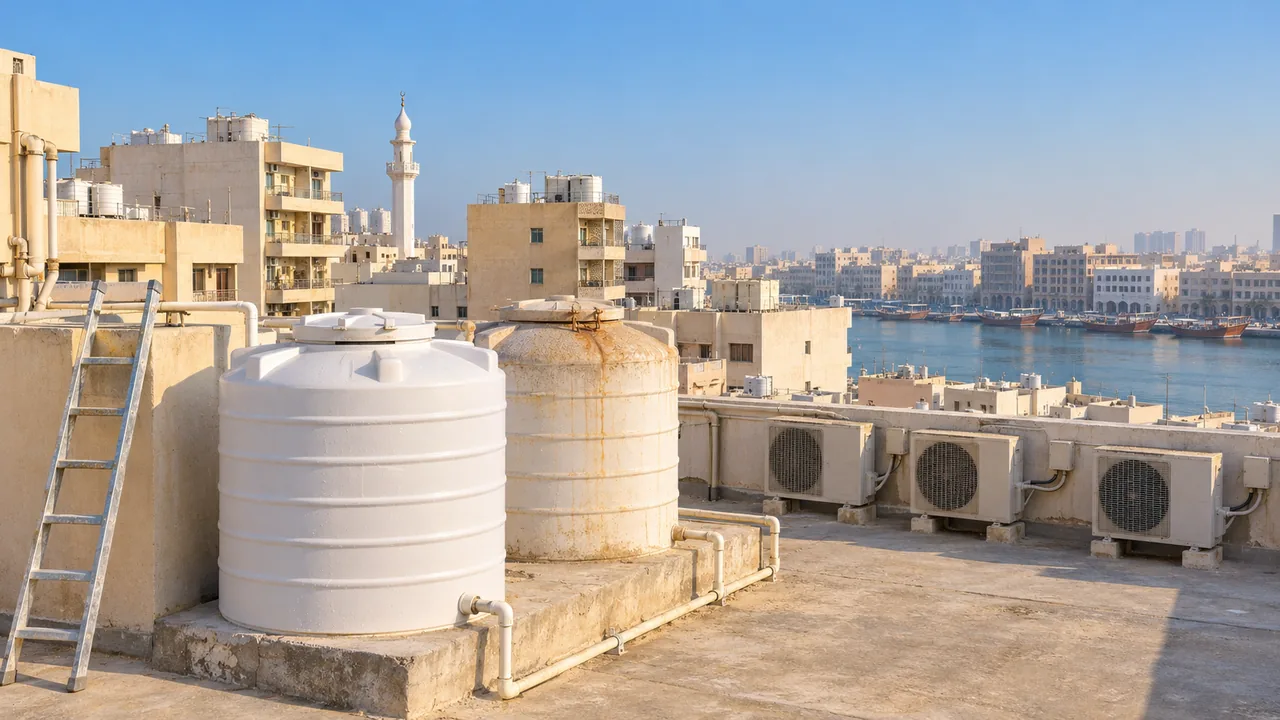
A building's water storage tank in Dubai must be emptied, cleaned and disinfected at least twice a year. The rule is in Dubai Municipality's Technical Guidelines for Legionella Control in Water System (DM-HSD-GU44-LCWS2, Version 6, issued 19 August 2025), which applies to "commercial, governmental and residential buildings" among others. Its checklist reads:
All water storage tanks shall be cleaned and disinfected with 50mg/l chlorine at least twice per year.
There is no separate quarterly rule for summer. What the guideline adds is a monthly check, and in an older building it is the clause to watch:
All water storage tanks shall be kept clean and inspected at least monthly. Ensure that all coverings are intact and firmly in place
A rusted lid or a hatch that no longer seals fails it, and sediment found at a check brings the clean forward: disinfection is required "If there is evidence of contamination or significant sediment during the periodic inspection of water storage tanks".
The duty sits with "The owners, principal manager, or person in charge of the premises". In practice, in a building held by one landlord, the landlord or the property manager acting for them; in a building sold unit by unit, the management entity that runs the common parts. The paperwork is part of the duty. The same checklist says "Water system cleaning and maintenance company shall be approved by Dubai Municipality" and "Water tank cleaning and disinfection certificate shall be valid", and water test results "must be available for inspection by the Dubai Municipality staff". Before booking, ask any contractor for proof of that approval. Reports go to the Municipality online, through its Building Health and Safety Compliance Test Reports e-service.
The procedure, the laboratory sample and the questions to ask a contractor are in the guide to Dubai Municipality's water tank rules.
Common areas: who is responsible in an older building
Responsibility for the common areas of an older building in Deira or Bur Dubai turns on one question: has the building been sold unit by unit, or is it held whole by one owner and let flat by flat and shop by shop?
A building sold unit by unit falls under Dubai's Law No. (6) of 2019 Concerning Ownership of Jointly Owned Real Property. The common parts are run by a management entity, paid for through service charges, and inspected and audited by RERA. Under Article 35, where common parts are "not duly maintained, or not preserved in a good, clean, and serviceable condition", RERA may serve a written notice on the management entity, and if the work is still not done, appoint another entity and charge the cost to the service charges account.
A building held by one owner and let to tenants runs on the relationship between landlord and tenant. Law No. (26) of 2007, Dubai's tenancy law, puts maintenance on the landlord in Article 16:
Unless otherwise agreed by the parties, the Landlord will, during the term of the Lease Contract, be responsible for the Real Property' maintenance works and for repairing any defect or damage that may affect the Tenant's intended use of the Real Property.
Article 19 asks the tenant to "maintain the Real Property in such a manner as an ordinary person would maintain his own property". In practice the landlord or property manager answers for the stairwell, the lobby and the refuse room, and the tenant keeps the flat, shop or office clean inside. Read the tenancy contract too, because the law lets the parties agree otherwise.
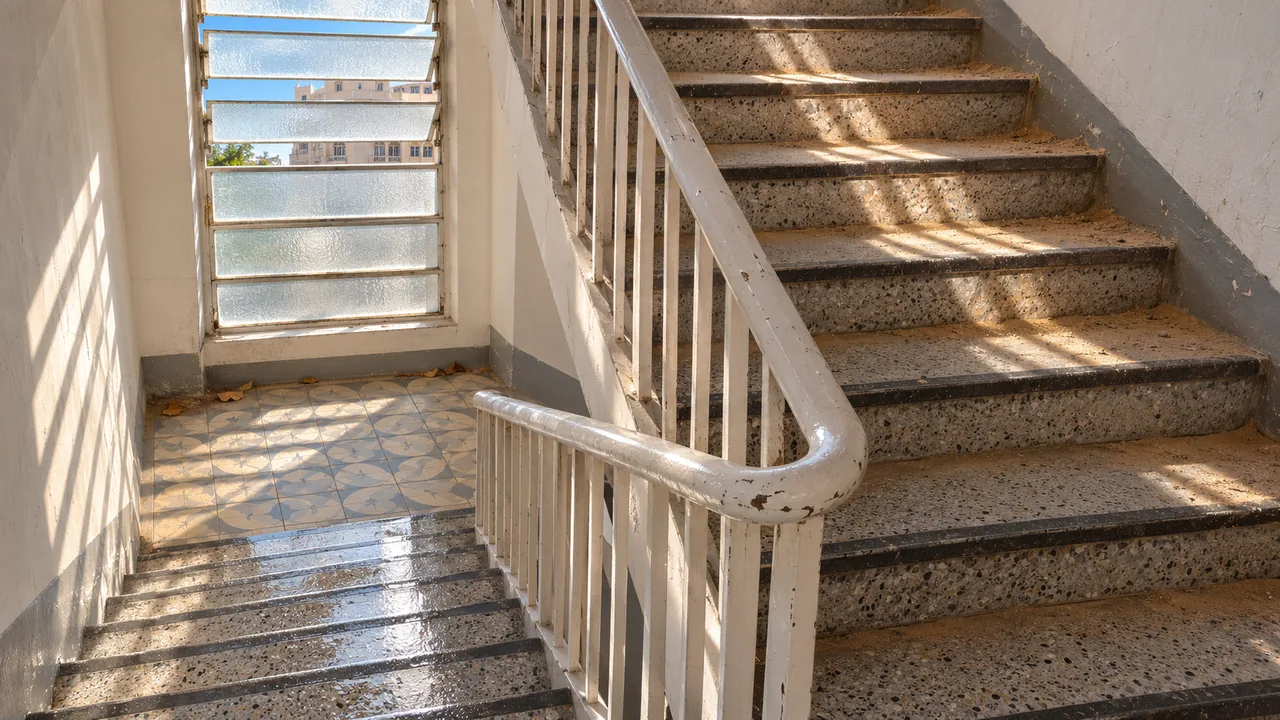
The common areas that need a fixed schedule are the lobby, stairwells and handrails, corridors, the refuse room, the roof and tank enclosure, and any car park. The full scope and frequencies are in the guide to common-area cleaning for Dubai buildings. Two points are particular to older stock: marble stairs need a neutral cleaner, for the reason given under kitchens below, and a refuse room with a slow drain stays dirty until the drain is fixed, which is a plumbing job first.
Shops and offices: cleaning outside opening hours
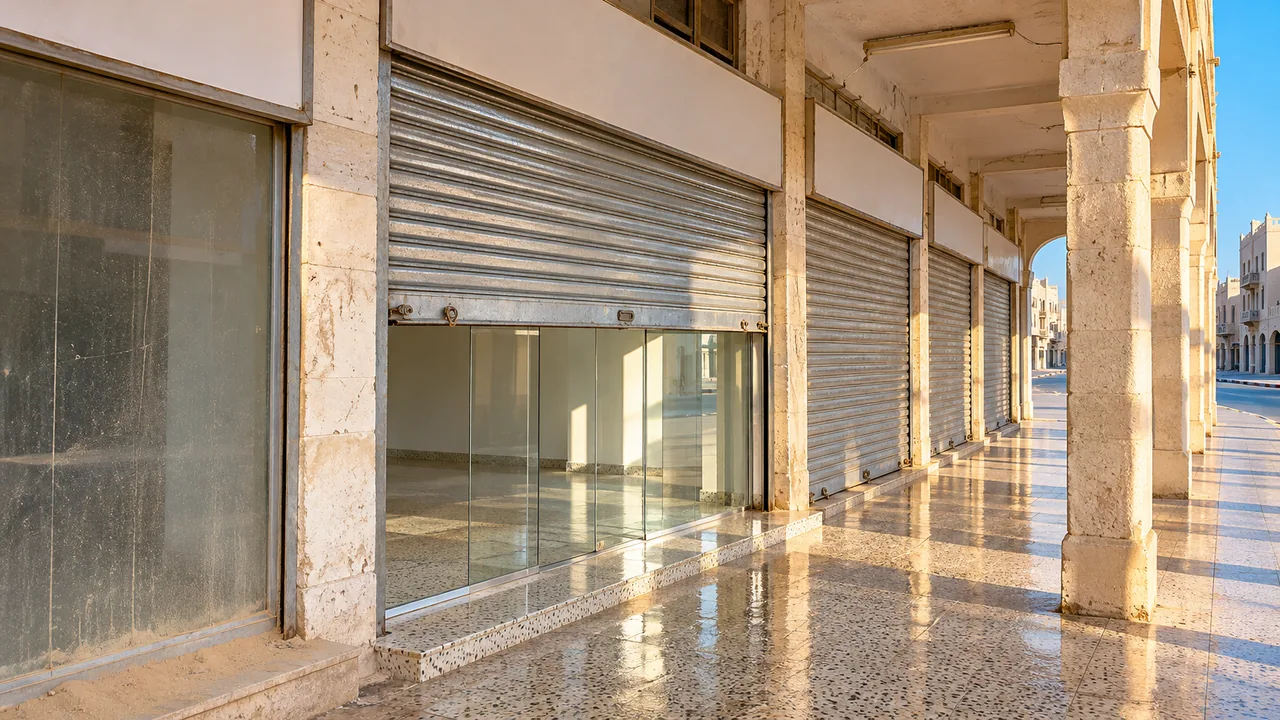
Shops and offices in Deira, Bur Dubai and Karama are cleaned outside trading hours, before the shutters go up or after they come down, so the work never competes with customers. Three things decide when a team can work:
- The building's rules. The landlord or building manager sets contractor hours, use of the service lift and where equipment can be unloaded. Get them in writing before agreeing a schedule.
- Access. A shop in a souk or arcade has a shutter and a lock; an office has a lobby and a key card. OUSIS offers a key or access code service and sends a completion notification when the work is done.
- The neighbours. Machines and water at street level, under flats, need hours that do not disturb the people above.
| Space | What it needs in an older district |
|---|---|
| Shop front | Glass inside and out, the shutter rails and the threshold, where street dust is walked in |
| Shop floor | Floors cleaned by surface, shelving and display fittings, fitting rooms |
| Office | Desks and touch points, glass partitions, carpets and chairs |
| Pantry | Hob, extract hood and splashback degreased; inside the fridge and microwave |
| Washrooms | Sanitising, descaling, grout and floor drains |
OUSIS's commercial cleaning covers offices, retail and warehouses on daily, weekly or monthly contracts, and teams bring all supplies and equipment. How to write scope, frequency and reporting into a contract is covered in the guide to office cleaning contracts in Dubai. Glass above street level and the facade are a separate question, covered in the guide to high-rise window and facade cleaning and by glass and facade cleaning.
Kitchens in older flats: degreasing, grout and stone
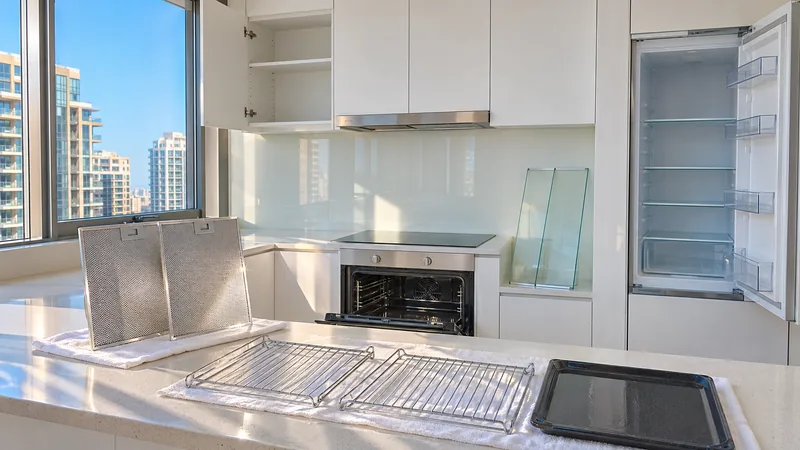
Kitchens in older flats need degreasing with more care than new ones, because grease has had years to settle into grout, onto cabinet tops and into extract fans. The order is high to low, so nothing cleaned is dripped on again:
- Hood filters and extract fans first, because grease drips from them onto everything below.
- Wall tiles and grout, with a degreaser suited to the tile; grout that has absorbed grease for years may stay darker than new.
- Cabinet tops and doors, including the tops of wall units, and the gap beside the cooker.
- Worktops by material. The Natural Stone Institute warns that "Products containing lemon, vinegar, or other acids may dull or etch calcareous stones", such as marble, and that "An oil-based stain will darken the stone and normally must be chemically dissolved and removed using a poultice to lift out the oils."
This is part of a deep clean, which OUSIS recommends every two to three months; the room-by-room scope is in the deep cleaning checklist, and damp bathrooms are covered in the guide to black mould in Dubai bathrooms. Restaurant kitchens are a different category: grease traps and exhaust ducts are specialist work under their own rules, not part of a clean.
Balconies, ledges and pigeons: what Dubai Municipality allows
Letting water run off a balcony while cleaning it, and feeding birds, both count as balcony misuse in Dubai. Reporting a Dubai Municipality advisory in December 2021, in which the municipality urged residents to "avoid distorting the city's general aesthetic and civilised appearance", Gulf News put the fines at Dh500 to Dh1,500, "depending on size of the balcony", without naming the order that sets them; the amounts date from 2021 and may have changed since, so check the current figure with the building management. Two items on its list of misuses bear directly on cleaning:
- "Flowing water down while cleaning balconies or letting the air-conditioning water spill."
- "Feeding birds, as they will leave their droppings in the place, and it may disturb the general appearance."
The same report adds that "Individual property owners and developers may also impose fines for misusing balconies". So a balcony is cleaned with as little water as possible: loose debris collected first, droppings softened and lifted, and the water sent to the balcony drain rather than over the edge.
Pigeon droppings need care. In 2018 Gulf News reported on residents in Deira and elsewhere troubled by them, quoting an Abu Dhabi-based consultant paediatrician: "The health risks from pigeon droppings arise from disease organisms which can thrive and grow". Guidance on removing bird droppings from the Centers for Disease Control and Prevention, the American public health agency, gives the working rule: "Avoid shoveling or sweeping dry, dusty material", and "carefully spray it to reduce the amount of aerosolized material". A ledge is never dry-brushed.
Keeping birds away is a separate decision. A municipality official told Gulf News in 2018 that control methods must be "humane, and are not visible on the balcony". Nets and spikes are for the building to approve, and anything involving pesticides is for a firm on Dubai Municipality's list of approved pest control companies (the list page was dated 3 September 2026 when this guide was written). The cleaning covers the balcony floor, glass, rails and the ledges within safe reach.
Al Qusais: homes beside an industrial area
Al Qusais is two places side by side: a residential area of mostly low-rise apartment blocks, and Al Qusais Industrial Area, which Bayut's area guide calls "the city's largest industrial development". The industrial area, a cluster of five sub-communities, lies along the border with Sharjah and holds offices, warehouses, shops, labour camps and factories, with car workshops among them.
For a flat nearby, that neighbour adds traffic and industrial dust to the dust every Dubai home gets. The guide to why Dubai homes get so dusty explains the sources; the practical answer is to clean the places dust reaches first, more often: glass, sliding tracks, balcony floors and air conditioning filters, which are AC maintenance.
Offices, warehouses and workshops inside the industrial area are commercial cleaning, and the guide to industrial and warehouse cleaning in Al Quoz, DIP and JAFZA covers units like these. Across the border, Al Nahda and Al Majaz in Sharjah have their own area guide; OUSIS covers Sharjah as well as Dubai.
A year in an older building
An older building runs on two clocks: the legal one for the tank, and the practical one for everything else.
| When | What | Service |
|---|---|---|
| Every month | Tank and coverings inspected; sediment found means a clean now | Building manager's check |
| At least twice a year | Tank emptied, cleaned and disinfected, with a laboratory sample afterwards | A water system company approved by Dubai Municipality |
| On a fixed schedule | Lobby, stairs, corridors, refuse room and roof | Villa and building cleaning |
| Before opening or after closing | Shops, offices and pantries | Commercial cleaning |
| Every two to three months | Flats deep cleaned: kitchen degreasing, grout, inside appliances | Deep cleaning |
| After dusty days | Glass, balconies and tracks, in the right order | After a sandstorm |
| Between tenancies | The empty-unit clean before the walk-through | Move-in and move-out cleaning |
| As needed | AC filters and servicing, drains, repainting | Property maintenance |
Between tenancies, Article 21 of the tenancy law asks the tenant to hand the property back "in the same condition in which the Tenant received it", ordinary wear and tear excepted; the guide to move-out cleaning and deposit deductions covers the walk-through.
OUSIS in Deira, Bur Dubai, Karama and Al Qusais
OUSIS is a professional cleaning and property services company working across Dubai and Sharjah. It handles post-construction cleaning, deep cleaning, move-in and move-out cleaning, villa and building cleaning, commercial cleaning, upholstery and fabric cleaning and property maintenance for contractors, developers, property managers, building owners and commercial tenants. Teams work in Deira, Bur Dubai, Al Karama and Al Qusais and across Dubai, from Business Bay and Downtown Dubai to Dubai Marina, and in Sharjah, seven days a week. OUSIS is rated 4.9 on Google.
In the older districts that means villa and building cleaning for common areas, commercial cleaning for shops, offices and warehouses, deep cleaning for flats, and property maintenance. Teams are background-checked, trained, uniformed, insured and supervised, and bring their own supplies and equipment. Send the building, the area, what needs cleaning and the hours the building allows work on WhatsApp, and a clear quote comes back, usually within the hour while OUSIS is open. Where a job needs a look first, such as a whole building, ask for a site visit. For newer towers, the Al Barsha and Barsha Heights guide is the counterpart to this one.
Questions people ask
How often must a building's water tank be cleaned in Dubai?
Dubai Municipality's guideline on legionella control (GU44, Version 6, issued August 2025) requires water storage tanks to be emptied, cleaned and disinfected at least twice a year, and kept clean and inspected at least monthly with all coverings intact. Sediment or contamination found at an inspection brings the clean forward, the cleaning company must be approved by Dubai Municipality, and the certificate and test results must be kept. OUSIS cleans the common areas, shops, offices and flats around them in Deira, Bur Dubai, Karama and Al Qusais.
Who is responsible for common-area cleaning in an older building in Deira or Bur Dubai?
It depends on how the building is owned. In a building sold unit by unit, Dubai's Law No. 6 of 2019 puts the common parts with a management entity, paid through service charges and inspected by RERA. In a building held by one landlord and let to tenants, Article 16 of the tenancy law makes the landlord responsible for maintenance unless the contract says otherwise. Tenants keep their own flat, shop or office clean. OUSIS cleans common areas for owners and property managers.
Does OUSIS clean shops and offices in Deira, Bur Dubai and Karama?
Yes. OUSIS provides commercial cleaning for offices, shops and warehouses in Deira, Bur Dubai, Al Karama and Al Qusais, on daily, weekly or monthly contracts or as a one-off deep clean. The work is scheduled around trading hours and the building rules for contractors, and teams bring all supplies and equipment. A key or access code service and a completion notification are available, and a clear quote comes back on WhatsApp, usually within the hour while OUSIS is open.
Can cleaning teams work outside opening hours in Deira and Bur Dubai?
Usually, but the building decides. Shops and offices in older buildings are cleaned before opening or after closing, within the hours the landlord or building manager allows contractors, with the service lift and unloading agreed in advance and noise kept down where flats sit above. Ask the building for its contractor hours in writing before fixing a schedule, and include them when requesting a quote from OUSIS so the plan fits them.
What are Dubai's balcony rules on cleaning and feeding pigeons?
Reporting a Dubai Municipality advisory in December 2021, Gulf News listed letting water flow down while cleaning a balcony, and feeding birds, among the forms of balcony misuse, with fines of Dh500 to Dh1,500 depending on the size of the balcony at the time; the amounts may have changed since, and owners and developers may add their own. Clean with little water, sent to the balcony drain, and dampen droppings before removing them rather than sweeping them dry. OUSIS cleans balconies, glass and ledges within safe reach.
Why do flats in Al Qusais get so dusty?
Al Qusais combines low-rise apartment blocks with Al Qusais Industrial Area, a cluster of warehouses, workshops, factories and offices along the border with Sharjah, so traffic and industrial activity add to the dust every Dubai home gets. Glass, sliding tracks, balcony floors and air conditioning filters show it first and need attention more often. OUSIS covers Al Qusais for deep cleaning and commercial cleaning, with AC filter cleaning and servicing as maintenance.
Sources
- Bayut: Deira area guide (read 10 November 2026)
- Bayut: Bur Dubai area guide (read 10 November 2026)
- Bayut: Al Karama area guide (read 10 November 2026)
- Bayut: Al Qusais area guide (read 10 November 2026)
- Bayut: Al Qusais Industrial Area guide (read 10 November 2026)
- Dubai Land Department: Old and new area names list (read 10 November 2026)
- Wikipedia: List of communities in Dubai, by sector (read 10 November 2026)
- Wikipedia: ADCB (Dubai Metro) (read 11 November 2026)
- Gulf News: Karama Shopping Complex, old district, new kaleidoscope (15 September 2018)
- Gulf News: Brand new Karama emerges from low-cost expat haven (5 November 2018)
- Frontiers in Built Environment: Historic districts in a global context, a comparative analysis of Dubai and Sharjah (30 April 2026)
- The National: Demolition day for hundreds of derelicts (23 December 2011)
- Emirates 24|7: 160 neglected buildings in Dubai face demolition (22 December 2011)
- The National: Run down buildings along Dubai Metro route told to smarten up appearance (16 May 2018)
- The National: Dubai Municipality completes renovation of Deira traditional markets (1 June 2019)
- Gulf News: Dubai restores 220 historic buildings, traditional markets (1 June 2019)
- Gulf News: Dubai to restore 35 additional heritage buildings and sites (12 May 2024)
- Dubai Municipality: Technical Guidelines 44 for Legionella Control in Water System, document page (read 10 November 2026)
- Dubai Municipality: DM-HSD-GU44-LCWS2, Technical Guidelines for Legionella Control in Water System, Version 6, issued 19 August 2025 (PDF)
- Dubai Legislation Portal: Law No. (6) of 2019 Concerning Ownership of Jointly Owned Real Property in the Emirate of Dubai
- Dubai Legislation Portal: Law No. (26) of 2007 Regulating the Relationship between Landlords and Tenants in the Emirate of Dubai
- Natural Stone Institute: Care and Cleaning of Natural Stone (2019)
- Gulf News: Hanging clothes in the balcony? These are the fines you face (27 December 2021)
- Gulf News: Pigeon droppings vex Dubai residents (1 November 2018)
- US Centers for Disease Control and Prevention (NIOSH): Histoplasmosis, elimination and engineering controls (updated 29 October 2026)
- Dubai Municipality: approved pest control companies, August 2026 list with guidance notes (PDF)